How NASA Treats Independent Inventors
Jed Margolin
Are you an Independent Inventor?
Have you had any dealings with NASA?
How did they treat you?
I am an independent inventor and I have had dealings with NASA.
They have acted very badly towards me.
That is why I am suing them.
I am going to blog this, so at this point I don’t know how it is going to
turn out.
As the process unfolds I expect we will learn a great deal about how Government
works.
For a direct index to the Court documents click
here.
To skip ahead to the most current blog entries click here.
Blog Index
January 1, 2010 - Introduction
July 31, 2009 - I file the Complaint in U.S. District Court for
the District of Nevada
August 1, 2009 - The Complaint appears in Pacer right away
August 5, 2009 - Summons issued as to USA; Judges assigned; My
Motion to be allowed to file electronically
August 22, 2009 - Certificate of Interested Parties; Federal
Rules of Civil Procedure; Local Rules; NASA responds (late) to my FOIA Appeal
August 28, 2009 - I file a Motion to correct the Docket Report
(which says I haven't served the U.S. Attorney)
September 4, 2009 - My Motion to be allowed to file
electronically is granted
September 13, 2009 - NASA will be defended by U.S. Attorney
for the District of Nevada (DOJ). Actually, NASA's Champion will be Assistant
U.S. Attorney Holly Vance. Holly files a Motion to
Dismiss because I named Charles F. Bolden, NASA Administrator as
Defendant instead of NASA.
September 25, 2009 - The Court issues a Klingele
Minute Order. It's like a One Minute Drill in football. I have to scramble. I respond and also file a Motion for Leave to File an Amended Complaint
as well as the Amended Complaint (First Amended Complaint)
September 26, 2009 - I discuss stare decisis.
The full phrase is stare decisis
et non quieta movere. You will see it translated in various ways. My
favorite is, “stand by the decision and do not disturb what is
settled.”
I provide a list of the cases cited so far.
October 9, 2009 - Holly filed a Response to my Opposition to
Motion to Dismiss. She also filed an Non-Opposition to
my Motion for Leave to File an Amended Complaint.
November 9, 2009 - The Court granted my Motion to Correct the
Docket Report
December 21, 2009 - In November 2009 I received about 4,000
pages of documents from NASA. Although many are redacted (some completely) they
tell a very different story about what NASA has been doing since I filed the
Claim for Compensation in 2003. It's mind boggling and my mind is appropriately
boggled.
December 22, 2009 - I filed a Motion for Leave to File an
Amended Complaint. This will be my Second Amended Complaint.
December 23, 2009 - I have posted the approximately 4,000 pages
of documents that NASA sent me in November. Do you know how long it takes
to scan 4,000 pages?
January 21, 2010 - Holly's Motion to Dismiss was still pending.
Motions have to be ruled on even if they are moot. A telephone conference
was scheduled to work it out (the Judge, Holly, and myself), and we did.
March 5, 2010 - I dropped Charles F.
Bolden, NASA Administrator as a Defendant and added National Aeronautics
and Space Administration.
March 10, 2010 - NASA 4,000 pages of documents
show they were interested in the Universal Avionics Systems Corporation (UASC)
lawsuit. The NASA documents included one of the UASC documents. I don't
think it was the best one. [I originally posted all of the publicly available
documents in the UASC case. Now I am just posting the best ones].
March 12, 2010 - I filed a second Freedom of Information Act request
with NASA. Their response was inadequate. I appealed. Later, they will deny my
Appeal. I didn't sue them over this one.
April 21, 2010 - Holly and I agreed to a schedule, and she
finally Answered the Complaint (the Second Amended Complaint).
April 23, 2010 - I received NASA's denial of my second FOIA
request. It was denied by Thomas S. Luedtke. Luedtke is like your high school's Vice-Principal. He is
NASA's Hatchet Man. Nonetheless, this FOIA request produced some useful
information.
June 9, 2010 - I filed my Motion for Summary Judgment.
September 9, 2010 - On September 7 NASA filed their Opposition
to Motion for Summary Judgment and Cross-Motion for Summary Judgment.
October 4, 2010 - I filed my Reply to NASA's Opposition to my
Motion for Summary Judgment and my Opposition to NASA's Cross-Motion for
Summary Judgment
November 9, 2010 - On November 1 NASA filed a Motion to Strike
and the Government's Reply. On November 8 I filed a
Motion Requesting Leave For Excess Pages, an
Opposition to Motion to Strike and Motion Requesting Leave to File Declaration,
and a Motion to Strike the Government's Reply.
November 24, 2010 - Holly's REPLY TO
OPPOSITION TO MOTION TO STRIKE AND OPPOSITION TO MOTION REQUESTING LEAVE TO
FILE DECLARATION.
December 3, 2010 - Holly filed a Notice of Errata. I filed my
Reply to Holly's Opposition to my Motion to Strike.
April 21, 2011 - The Court's Decision (March 31, 2011), My
Motion for Costs (April 3, 2011), Holly's Response (Opposition) to my Motion
for Costs (April 20, 2011)
April 25, 2011 - I file my Response to NASA's Response to My
Motion For Costs
October 22, 2011 - a Tardy Update
October 22, 2011 (Continued)
December 7, 2011 - on November 3, 2011 the Court ordered
NASA to pay me $525.06 in costs. It has been 33 days and NASA has not paid me.
February 6, 2012 - NASA hasn't paid me and they ignored my email
of January 6. Today I filed a Motion to Compel NASA to disclose their assets in
Nevada . I also moved that NASA be held in contempt.
May 30, 2012 – NASA’s Excuses for not paying me
June 2, 2012 – My Reply to NASA’s Excuses
January 1, 2010
I contacted NASA in May 2003 because I thought they had infringed one of my
patents in their X-38 project. I wanted a friendly conversation because I
thought they should buy the patent in order to control the technology.
NASA did not want a friendly conversation. They suggested I file a claim for
compensation, so I did that.
Then they told me that they would conduct an investigation (expected to last
three to six months) and that the purpose of the investigation would be to find
prior art to invalidate my patent.
After six months I contacted them to find out the results of the investigation.
They said it hadn't been done yet. They also said that since I was an
independent inventor my patent had to be crap anyway. They said some
other things, too.
After that, they refused to talk to me.
Afterwards, I assigned the patent to Optima Technology Group, and the claim went
with it.
I still wanted to know what had happened with the investigation so in July 2008
I filed a FOIA Request with NASA.
They asked for an extension of 90 days to respond and I said ok. Still, it
wasn't until May 2009 that they sent me any documents. Most of the documents
they sent me were documents I already had because they were documents I had
sent to NASA.
I filed an Appeal with NASA. After their deadline for
responding to the Appeal had passed they asked me for an extension. This
time I said no, and in July 2009 I filed a lawsuit in U.S. District
Court for the District of Nevada.
As of January 2010 the case has not yet gotten off the ground but in November
2009 NASA gave me about 4,000 pages of documents. Until then I thought NASA had
been ignoring me all those years. The documents tell a very different story.
It's a story of deception, conspiracy, and criminal misconduct by a rogue group
within NASA. And we learn that the humble Peanut Butter and Jelly Sandwich
is a good metaphor for Patents.
If you want to skip ahead to the most interesting part so far click here.
July 31, 2009
It’s a long story, but can be summarized in the Complaint I have filed
against NASA in the U.S. District Court for the District of Nevada. I have
added active links to the exhibits and references.
COMPLAINT FOR INJUNCTIVE RELIEF
1. This is an action under the Freedom of Information Act, 5 U.S.C. § 552 (2007) (“FOIA”), for
injunctive and other appropriate relief seeking the disclosure and release of
agency records improperly withheld from plaintiff by defendant Charles F.
Bolden, Administrator of the National Aeronautics and Space Administration.
Jurisdiction and Venue
2. This Court has subject matter jurisdiction over
this action and personal jurisdiction over the parties pursuant to 5 U.S.C. § 552(a)(2)(A), 5
U.S.C. § 552(a)(2)(C), 5 U.S.C. §
552(a)(3)(A), 5 U.S.C. § 552(a)(3)(C) , 5 U.S.C. § 552(a)(6)(A)(ii), and 5 U.S.C. § 552(a)(6)(F).
3. Venue is proper in this district pursuant to Section 552(a)(4)(B), as
this is the district in which plaintiff resides.
Parties
4. Plaintiff Jed Margolin (“Margolin”) is an engineer and independent inventor
who resides at 1981 Empire Rd., VC Highlands,
5. Defendant Charles F. Bolden is the Administrator for the
National Aeronautics and Space Administration (“NASA”), which is an
independent administrative agency within the Executive Branch of the United
States. NASA is an agency within the meaning of 5
U.S.C. § 552(f)(1).
Statement of Facts - Background
6. Margolin is the named inventor
on U.S. Patent 5,904,724 Method and apparatus for remotely piloting an
aircraft issued May 18, 1999 (the ‘724 patent). The front page of the
patent is in Exhibit 1, Appendix A12. The patent
teaches the use of what is now called synthetic vision for controlling
an unmanned aerial vehicle (UAV).
7. Margolin contacted NASA in May
2003 after he became aware that NASA had used synthetic vision in the X-38
project. Because the use of synthetic vision for controlling a UAV can be used
to the detriment of this country by unfriendly entities he wanted a friendly
conversation because he thought NASA should buy the patent in order to control
the technology.
8. In June 2003 Margolin was turned
over to Mr. Alan Kennedy in the Office of the General Counsel. This is what Margolin recorded in his Contact Log:
Summary: He basically said that what most independent inventors have is junk and that since I am an independent inventor what I have is probably junk. If NASA evaluates it as a license proffer it will give it a pro forma rejection and I will file a claim anyway, so the same people who rejected it as a proffer will reject it as a claim, but in the process will have had to do more work, so to save them some work they will ignore the proffer and handle it as a claim.
9. As a result, Margolin filed a
claim, completely answering all the questions on NASA’s claim form. See Exhibit 1, Appendix A2. Then Mr. Kennedy informed him
that NASA would conduct an investigation (expected to last 3-6 months) and that
the purpose of the investigation would be to find prior art to invalidate the
patent.
10. After six months Margolin did
not hear from NASA so he called Mr. Kennedy, who said:
a. The investigation had not been done.
b. NASA had a Research Exemption for using the patent. Margolin advised him this was not true. See Madey v. Duke 307 F.3d
1351 (Fed. Cir. 2002).
c. "The X-38 never flew." Margolin
informed him of the video on NASA's web site showing the X-38 flying.
d. The Statute of Limitations gives NASA 6 years to respond
to his claim.
e. It would cost Margolin more to
sue NASA in Federal Claims Court than he could hope to recover from NASA.
11. After that, Mr. Kennedy refused to talk to Margolin or respond to his letters. Then, various things
came up and Margolin was unable to pursue his claim
against NASA.
12. Subsequently, Margolin assigned
the patent to Optima Technology Group, a Delaware Corporation. The claim
against NASA went with the patent.
Statement of Facts - Current Case
13. Although Margolin no longer
owned the claim against NASA he still wanted to know the results of
NASA’s investigation so, on July 1, 2008 he filed a FOIA request. See Exhibit 2, Appendix A17. It was assigned FOIA HQ
08-270. For some reason it was turned over to Mr. Jan McNutt in the Office of
the General Counsel. Mr. McNutt’s response is Exhibit
3, Appendix A19. In his response Mr. McNutt admitted that no investigation
had been done and asked Margolin to give NASA a 90-day
extension to his FOIA request.
14. Margolin agreed to the
extension. See Exhibit 4, Appendix A21. However,
despite being told several times that the requested documents were being sent
out, NASA did not send any documents to Margolin
until May 18, 2009. It is likely that the reason NASA finally responded to Margolin’s FOIA Request is the fax he sent to Acting
Administrator Christopher Scolese where he asked Mr. Scolese to confirm that he had exhausted all the administrative
remedies that NASA had to offer. See Exhibit 5, Appendix
A23. Margolin had previously sent the
letter to Mr. Scolese by Certified Mail, but USPS did
not deliver it and still has no explanation how or where it was lost.
15. NASA’s response to Margolin’s
FOIA Request is in Exhibit 6, Appendix A27. The
documents themselves have been omitted from this Complaint due to their length.
The NASA Response states:
It has been determined that portions of the records found responsive to your request contain information which is exempt from disclosure under the deliberative process privilege of Exemption 5. This privilege covers advisory opinions, recommendations, and deliberations, which are part of the government decision-making process, 5. U.S.C. § 552(b)(5).
It should be noted that 5 U.S.C. § 552(b)(5) actually states, referring to Section (a) which
requires agencies to make information available to the public:
(b) This section does not apply to matters that are -
.
.
.
(5) inter-agency or intra-agency memorandums or
letters which would not be available by law to a party other than an agency in
litigation with the agency;
16. Although 5 U.S.C. § 552(a)(6)(F) requires agencies to give an estimate of the
volume of the documents being withheld, NASA failed to do so.
17. One of the documents that NASA
withheld from Margolin is a letter dated March 19,
2009 that was sent by Gary G. Borda (“Borda”) NASA Agency Counsel for Intellectual Property
to Optima Technology Group (“OTG”). See Exhibit
7, Appendix A30. This document was given to Margolin
by OTG. In this letter Borda denies Claim I-222
regarding NASA’s infringement of U.S. Patent 5,904,724 (‘724) in
the X-38 project. Margolin’s FOIA 08-270
request to NASA was to produce documents relating to Claim I-222 and NASA
withheld the most material document so far. The Borda
letter asserts:
“… numerous pieces of evidence were uncovered which would constitute anticipatory prior knowledge and prior art that was never considered by the U.S. Patent and Trademark Office during the prosecution of the application which matured into Patent No. 5,904,724.”
And states, “… NASA reserves the right to introduce such evidence
of invalidity in an appropriate venue, should the same become necessary.”
The exemption claimed by NASA in their FOIA Response was for:
(5) inter-agency or intra-agency memorandums or letters which would not be available by law to a party other than an agency in litigation with the agency;
Optima Technology Group is not an agency under 5
U.S.C. § 552(f)(1). It is a private company. And circulating the Borda patent report solely within NASA or among other
federal agencies is not an appropriate venue for NASA to use to have a patent
declared invalid. The only appropriate venues for NASA to challenge the
validity of a U.S. Patent are in the U.S. Court of Federal Claims and the U.S.
Court of Appeals for the Federal Circuit.
Therefore, the exemption NASA claims under 5
U.S.C.§552(b)(5) does not apply.
There is another reason NASA needs to produce the Borda patent report. Although Margolin
no longer owns the ‘724 patent he is still the named inventor. By
asserting it has evidence to invalidate the patent, and then withholding that
evidence, NASA has defamed Margolin’s
reputation as an inventor. It smacks of 1950s McCarthyism (making damaging
accusations without providing proper evidence).
18. Margolin filed a FOIA Appeal on
June 10, 2009. The Margolin Appeal is Exhibit 8, Appendix A36. The Appendices in the appeal
have been omitted due to their length. Margolin’s
FOIA Appeal was received at NASA Headquarters on June 12, 2009. See Exhibit 9, Appendix A57.
19. On Monday, July 21, 2009, Margolin
called the NASA Office of the General Counsel to inform NASA that they had
failed to respond by the 20 day statutory deadline required by 5 U.S.C. § 552(a)(6)(A)(ii), and to ask what
NASA’s intentions were. Margolin spoke to Mr.
Randolph Harris who said he would look into the matter and call him back later
that day. Mr. Harris did not call Margolin back that
day, so the next day Margolin called Mr. Harris. Mr.
Harris said that NASA would be sending Margolin a
bunch of documents but he did not know what the documents were or when they
would be sent. He guessed seven days. Margolin also
asked whether NASA would waive legal service and accept a Complaint by USPS
Express Mail. Mr. Harris said, “No.” Only Certified
mail. After Margolin told him about the problem when
he had sent NASA the letter of April 6, 2009 to Acting Administrator Scolese (USPS never delivered it) Mr. Harris still said,
“No.” Margolin emailed Mr. Harris a
letter asking him to confirm what he had said in the telephone conversation.
See Exhibit 10, Appendix A59.
20. Margolin did not receive a
reply from Mr. Harris. Instead he received an email from Mr. Jan McNutt, who
asked for a 20-day extension for NASA to respond to Margolin’s FOIA Appeal. See Exhibit 11, Appendix A61. Whereas Mr. Harris had
promised NASA would be sending more documents, Mr. McNutt did not. Since NASA
had been acting in bad faith toward Margolin for over
six years and Mr. McNutt had already taken improper advantage of the number of
courtesies Margolin had extended to him regarding Mr.
McNutt’s actions in the FOIA request, Margolin
said, “No” to Mr. McNutt’s request for an extension. See Exhibit 12, Appendix A63. NASA had failed to respond
to his FOIA Appeal (or ask for an extension) within the 20 day statutory period
required by FOIA, and there was no reason to believe NASA had changed course
and was suddenly going to start acting in good faith.
21. It is possible that Mr. Borda
was being mendacious in his letter of March 19, 2009 when he said that NASA had
prior art to invalidate the ‘724 patent. See Exhibit
7, Appendix A30. Otherwise he would have produced the patent report,
or at least listed the evidence, to prove his point. It is possible that Mr.
McNutt’s request for an extension is to give NASA time to look for some.
Therefore, time is of the essence in compelling NASA to respond now.
22. Mr. Mike Abernathy of Rapid Imaging Software co-authored
an article in AUVSI’s Unmanned Systems Magazine which presented a spurious
history of synthetic vision (Synthetic Vision Technology for Unmanned
Systems: Looking Back and Looking Forward by Jeff Fox, Michael Abernathy,
Mark Draper and Gloria Calhoun). See Exhibit 13,
Appendix A66. Margolin responded with the article
Synthetic Vision – The Real Story. See Exhibit 14, Appendix A69. Although the editor of AUVSI
Magazine had promised Margolin the opportunity to
respond in the magazine, he later refused to even mention the controversy about
the Abernathy article. See Exhibit 15, Appendix A127.
As result, Margolin posted his response on his
personal web site at www.jmargolin.com .
Mr. Abernathy’s company provided the
synthetic vision software for the X-38 project (Exhibit
1, Appendix A3) which is why NASA should disclose their contacts with Mr.
Abernathy and his company regarding the I-222 claim, the ‘724 patent, and
NASA’s allegation that it has prior art to invalidate the ‘724
patent.
Requested Relief
WHEREFORE, plaintiff respectfully requests that this Court:
A.
Order defendant to disclose requested records in their entireties and provide
copies to plaintiff, said records to include the patent report alleged to
exist, but not provided in the Borda letter, and
contacts between NASA and Mike Abernathy (and/or Rapid Imaging Software and/or
its employees and/or agents);
B. Issue an Order finding that defendant’s actions were
in bad faith, arbitrary, capricious, and contrary to law;
C. Provide for expeditious proceedings in this action;
D. Award plaintiff his costs incurred during the
administrative proceedings and in this action; and
E. Grant such other relief as the Court may deem just and
proper.
Respectfully submitted,
/Jed Margolin/
Jed Margolin, plaintiff pro se
1981 Empire Rd.
VC Highlands, NV 89521-7430
775-847-7845
jm@jmargolin.com
Dated: July 31, 2009
I filed the Complaint on Friday morning July 31, 2009. It was immediately given
the case number 3:09-cv-00421.
As a non-attorney I have to file a motion to use the Court's electronic filing
system (CM/ECF). In order to file a motion you have to first file a Complaint.
As a result, I filed the Complaint on paper.
August 1, 2009
The complaint was scanned and appeared in Pacer the
next day. (That was fast.) Anyone can search Pacer (http://dockets.justia.com) but you need a
Pacer account to download documents. The good news is that anyone can get a
Pacer account. The bad news is that it costs money to download documents.
Pacer:
The Pacer files might not look great when viewed on-screen, but if you print
them out they look good. Indeed, considering the amount of data compression
that was used, they look very good.
These are higher quality PDFs (with some color
picture) made from the files I used to write the Complaint:
Complaint: jm_nasa_complaint.pdf
Appendix: jm_nasa_appendix.pdf
(3 MBytes)
I also split the appendix into two smaller files, each less than 2 MBytes:
If you want to see my NASA FOIA Appeal click here. It includes the FOIA Appeal Appendix which
contains all of the documents NASA produced in response to my FOIA request.
August 5, 2009
From Pacer:
Document 2 Filed & Entered: 07/31/2009
Summons Issued as to
Filed & Entered: 08/03/2009 Assign Judges in Civil Case
Document 3 Filed: 08/03/2009
Entered: 08/05/2009
Motion for Pro Se Litigant to File Electronically
doc003.pdf
August 22, 2009
It was a busy week.
On Monday, August 17, I went down to the Reno
Post Office to get proof of delivery of the copies of the Summons and Complaint
that I sent to NASA and the Attorney General by Registered Mail. Although
I paid for a Return Receipt (green postcard) I did not get one returned from
NASA and the one that was returned from the Attorney General was not signed. It
was stamped. The stamp is illegible except for the date: August 7. It was
not delivered on August 7. The USPS official records for the delivery of
the documents show the signatures of the persons receiving the documents and
the date the mail was delivered. They were delivered on August 6. Something
here smells.
On Tuesday, August 18, I went down to the
The reason I had to make the trip is because my motion
to allow me to register for the Court's CM/ECF system (the Court's
electronic filing system) has not been acted on.
On Wednesday morning, August 19, I was checking Pacer to see if there were any
new entries and I clicked on the wrong box. Instead of clicking on History/Documents
I clicked on Docket Report.
Docket Report contains more information than History/Documents.
The entry for the day I filed the Complaint says:
|
Date Filed |
# |
Docket Text |
|
07/31/2009 |
1 |
COMPLAINT against Charles F. Bolden, filed by Jed Margolin. ($350.00 FILING FEE PAID 7/31/2009: RECEIPT #21577) Certificate of Interested Parties due by 8/10/2009. Proof of service due by 11/28/2009. (Attachments: # 1 Exhibits, # 2 Civil Cover Sheet)(PM) Modified on 7/31/2009 to clarify text(PM). (Entered: 07/31/2009) |
My attention was drawn to the part that says, "Certificate of Interested
Parties due by 8/10/2009." Oops.
The Federal Rules of Civil Procedure (http://www.uscourts.gov/rules/CV2008.pdf)
Rule 7.1. Disclosure Statement says:
(a) WHO MUST FILE; CONTENTS. A nongovernmental corporate party must file 2 copies of a disclosure statement that:
(1) identifies any parent
corporation and any publicly held corporation owning 10% or more of its stock;
or
(2) states that there is no such corporation.
(b) TIME TO FILE; SUPPLEMENTAL FILING. A party must:
(1) file the disclosure statement
with its first appearance, pleading, petition, motion, response, or other request
addressed to the court; and
(2) promptly file a supplemental statement if any required information changes.
(As added Apr. 29, 2002, eff. Dec. 1, 2002; amended Apr. 30, 2007, eff. Dec. 1,
2007.)
I am not a corporate party, so I did not file one.
However, in the Local Court Rules for the District Court for the District of
Nevada, Rule LR 7.1-1 says:
LR 7.1-1. CERTIFICATE AS TO INTERESTED PARTIES.
(a) Unless otherwise ordered, in all cases except habeas corpus cases counsel for private (nongovernmental) parties shall identify in the disclosure statement required by Fed. R. Civ. P. 7.1 all persons, associations of persons, firms, partnerships or corporations (including parent corporations) which have a direct, pecuniary interest in the outcome of the case.
The disclosure statement shall include the following certification:
"The undersigned, counsel of record for ______, certifies that the following have an interest in the outcome of this case: (here list the names of all such parties and identify their connection and interests). These representations are made to enable judges of the Court to evaluate possible disqualification or recusal.
Signature, Attorney of Record for _______ "
(b) If there are no known interested parties other than those participating in the case, a statement to that effect will satisfy this rule.
(c) A party must promptly file a supplemental certification upon any change in the information that this rule requires.
(
I still don't think I needed to file a Certificate of Interested Parties, but
it was either that or file a motion to correct the Docket Report.
So, on Wednesday, August 19 I went down to the
Before going to the Courthouse I went to the U.S.
Attorneys Office (located a block away from the
I did not send copies to NASA or the Attorney General. The reasons I did not
send them copies are:
1. Both NASA and the Attorney General's Office have told
me they will not accept delivery of documents other than by mail. And they
will not accept USPS Express Mail;
2. The Post Office can no longer be relied upon to do its job. They lose
Certified Mail and are not able to track it. They lose Return Receipts
from Registered Mail. Getting Proof of Delivery for Registered Mail requires
another trip to the Post Office, and when the staff at the Post Office see that
I am next in line they close their windows and hide in the back room;
3. There is only one Defendant (Charles F. Bolden, NASA Administrator)
and, until I am told otherwise, the U.S. Attorney in
By the way, since both NASA and the Attorney General refused to waive Service
and insisted that I use USPS to deliver the Summons and Complaint to them
(except by Express Mail), it can be argued that both
NASA and the Attorney General have designated USPS to be their Agent.
Therefore, the Summons and Complaint can be considered as having been served
when I handed them to USPS on August 1, not when USPS delivered them on August
6.
Something interesting happened the week before last.
NASA responded to my FOIA Appeal. It was dated August 5, mailed August 6, and I
received it August 10. They denied my Appeal.
Here is a PDF scan of the letter: nasa_foia_appeal_response.pdf
I have used OCR to convert it to text and make an html file: nasa_foia_appeal_response.htm
Here is the timeline for NASA's letter:
July 31, 2009
Friday I filed the Complaint. The Pacer entry that I had
filed the Complaint appeared later that same day.
August 1, 2009 Saturday
The Complaint appeared in Pacer; I mailed the Summons and Complaint to
NASA and the Attorney General.
August 3, 2009 Monday I filed the
Motion to file electronically. I also personally delivered the Summons and
Complaint to the Office of the U.S. Attorney for the District of Nevada.
August 5, 2009 Wednesday The date on the letter from NASA denying my FOIA Appeal.
August 6, 2009 Thursday
NASA mails their letter.
August 10, 2009 Monday
I receive NASA's letter.
It is entirely reasonable to assume that NASA knew I had filed the Complaint -either
from Pacer or by being informed by the U.S. Attorney for the District of
Nevada- and had read the Complaint before they mailed their letter
denying my FOIA Appeal. Their letter was too little and too late.
There is one more thing that is interesting about NASA's letter. My FOIA Appeal
was denied by Thomas S. Luedtke, Associate
Administrator for Institutions and Management. A Google search for Mr. Luedtke ("Thomas S. Luedtke")
produces a large number of hits. Many of them relate to this story from CBS
dated October 22, 2007: http://www.cbsnews.com/stories/2007/10/22/travel/main3390456.shtml
which starts out:
(AP) Anxious to avoid upsetting air travelers,
NASA is withholding results from an unprecedented national survey of pilots
that found safety problems like near collisions and runway interference occur
far more frequently than the government previously recognized.
NASA gathered the information under an $8.5 million safety project, through
telephone interviews with roughly 24,000 commercial and general aviation pilots
over nearly four years. Since ending the interviews at the beginning of 2005
and shutting down the project completely more than one year ago, the space
agency has refused to divulge the results publicly.
Just last week, NASA ordered the contractor that conducted the survey to purge
all related data from its computers.
The Associated Press learned about the NASA results from one person familiar
with the survey who spoke on condition of anonymity because this person was not
authorized to discuss them.
A senior NASA official, associate administrator Thomas S. Luedtke, said revealing the
findings could damage the public's confidence in airlines and affect airline
profits. Luedtke acknowledged that the survey results
"present a comprehensive picture of certain aspects of the
The AP sought to obtain the survey data over 14 months under the U.S. Freedom
of Information Act.
"Release of the requested data, which are sensitive and safety-related,
could materially affect the public confidence in, and the commercial welfare
of, the air carriers and general aviation companies whose pilots participated
in the survey," Luedtke wrote in a final denial
letter to the AP. NASA also cited pilot confidentiality as a reason, although
no airlines were identified in the survey, nor were the identities of pilots,
all of whom were promised anonymity.
.
.
.
Here is the NASA FOIA file for AP's request for the NAOMS (National
Aviation Operations Monitoring Service) study: http://www.governmentattic.org/docs/Track-info-FOIARequest_NASAAirSafetySurvey_2006-07.pdf
. Mr. Luedtke's denial of AP's appeal starts
on PDF page 182.
NASA produced a redacted version of the study on December 31, 2007 and was
criticized for redacting it so heavily, such as in this blog by Christopher
Elliot: http://www.elliott.org/blog/redacted-nasa-airline-safety-study-released-sorta/
. Mr. Elliot is a journalist who writes about travel. Among other things
he is National Geographic Traveler magazine’s reader
advocate and writes the nationally syndicated Travel
Troubleshooter column, which appears in more than 50
NASA's web page for the NAOMS documents is here: http://www.nasa.gov/news/reports/NAOMS.html
I don't know how many of the documents are still redacted. There are lots
of documents. The documents I have looked at seem to be complete. If NASA had
released these documents and not tried to hide them, I doubt there would have
been a political firestorm.
The question is, what did NASA learn from this fiasco?
1. Did they learn not to withhold information?
2. Did they learn to withhold information better?
3. Did they develop a bunker mentality?
So far, it looks like the answers are: No, Yes, and Yes.
August 28, 2009
On Monday, August 24, I filed a Motion to Correct the Docket Report. The Docket
Report says that the U.S. Attorney was not served. Yes, he was. See doc006.pdf
My Motion appeared on Pacer on August 27.
According to the Docket Report Bolden/NASA has until September 11 to respond.
According to Local Rules, Parties have 15 days to respond to a Motion but it
isn't clear how this is calculated. September 11 is 15 calendar days from
August 27. It is 15 calendar days from August 26 if we give them Labor Day off.
If we give them Labor Day and weekends off (thus counting only business days)
it is 15 business days from August 20. It looks
like the 15 days are from when it appeared in Pacer, except I personally
delivered the Motion to the U.S. Attorney's Office on August 24. Since my
Motion to be allowed to file electronically has not been heard yet,
the U.S. Attorney gets two extra days to respond.
Presumably, Bolden/NASA will be represented by the U.S. Attorney. If the U.S.
Attorney objects to having the Docket Report corrected I will know that I am in
for a very dirty fight.
September 4, 2009
My Motion for permission to register for and use the Court's CM/ECF system was
granted. on August 31. See doc007.pdf
September 13, 2009
It looks like I am in for a very dirty fight,
but not for the reason I thought.
The U.S. Attorney for the District of Nevada will be defending NASA. This is
not a big surprise but it is disappointing. The U.S. Attorney is supposed to
work for the People of the
The U.S. Attorney did not oppose my motion to correct the Docket Report.
See doc008.pdf
However, he (she) filed a Motion to Dismiss based on the theory that:
A. This action should be dismissed because individual agency officials are not proper defendants in actions under the Freedom of Information Act ("FOIA").
See doc009.pdf
Hmmm.
September 25, 2009
As a result of the U.S. Attorney's Motion to Dismiss, the Court issued a Klingele Minute Order informing me of the requirements
of Klingele v. Eikenberry.
See doc010.pdf
The second paragraph appears to apply to this case:
Pursuant to the last sentence in Fed. R. Civ. P. 12(b), if evidence is submitted with a motion to dismiss and considered by the court, then the motion will be treated as a motion for summary judgment. The same is true regarding a motion for judgment on the pleadings. See Fed. R. Civ. P. 12(c). This notice is issued, in part, to alert the plaintiff that if defendants have submitted evidence in support of a motion to dismiss or a motion for judgment on the pleadings, then the court may treat the pending motion as a motion for summary judgment. If the court grants summary judgment, then judgment may be entered against plaintiff and this lawsuit will end without trial. This notice contains important information about what you need to do to oppose the motion. Please read it carefully.
It looks like the U.S. Attorney's Motion to Dismiss must also be treated as a Motion For Summary Judgment.
However, since the U.S. Attorney hasn't Answered the Complaint yet, it put me in the awkward position of having to respond to legal arguments that, technically, had not yet been made.
When life hands you lemons, make lemonade. So I did.
I filed a Memorandum of Points and Authorities In Support of Plaintiff's
Opposition to Motion to Dismiss.
See doc011-1.pdf
Memo of Opposition
See doc011-2.pdf
Memo of Opposition Appendix
I also filed a Motion For Leave to File an Amended
Complaint. If amending the Defendant makes everyone happy, fine.
Since NASA sent me their Denial of my Appeal only after I filed the Complaint I
added that, too.
And I corrected a few minor things in my Complaint, like I forgot to add the
section Cause of Action. (Actually, that was a major thing.)
A Motion for Leave to File an Amended Complaint must be accompanied by the
proposed Amended Complaint.
See doc012-1.pdf
Motion For Leave to File an Amended Complaint
See doc012-2.pdf
First Amended Complaint
See doc012-3.pdf
Appendix-1 (1.6 MBytes)
See doc012-4.pdf
Appendix-2 (2 MBytes)
It was necessary to split the Appendix into two files because there was a file
size limitation of 2 MBytes. I have since been
told that the file size limitation has been increased to 5 MBytes.
I used the Court's CM/ECF system. It's a good, easy-to-use system. However, as
a non-attorney I had to file a Motion to get permission to use it. (My Motion
was granted in doc007.pdf .)
The court's CM/ECF system added the header to each page but did not do anything
else to the files. The files in Pacer are essentially the files I uploaded.
That's good because I took special care to produce high quality files. I
have written about making PDF files in a separate article: MakingPDF.htm
September 26, 2009
When you read legal briefs and Court opinions they
always have those cryptic references to other cases.
The reason is stare decisis.
I talk about stare decisis in the introduction
to a page of cases I have posted because they have either been cited in my
FOIA case or because I found them useful or interesting.
Most of the cases listed are downloadable.
Click here for FOIA Cases and Statutes.
October 9, 2009
On October 7, the U.S. Attorney filed a Response to my Opposition to Motion to
Dismiss (doc011-1.pdf)
See doc013.pdf
On October 9, the U.S. Attorney filed a Non-Opposition to my Motion For Leave
to File an Amended Complaint (doc012-1.pdf)
See doc014.pdf
November 9, 2009
On November 3 the Court issued an order granting my Motion to Correct the
Docket Report (doc006.pdf).
See doc015.pdf
December 21, 2009
On November 16, 2009 I received two boxes of documents from NASA.
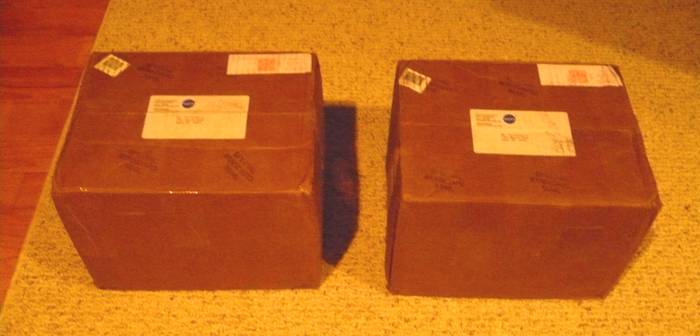
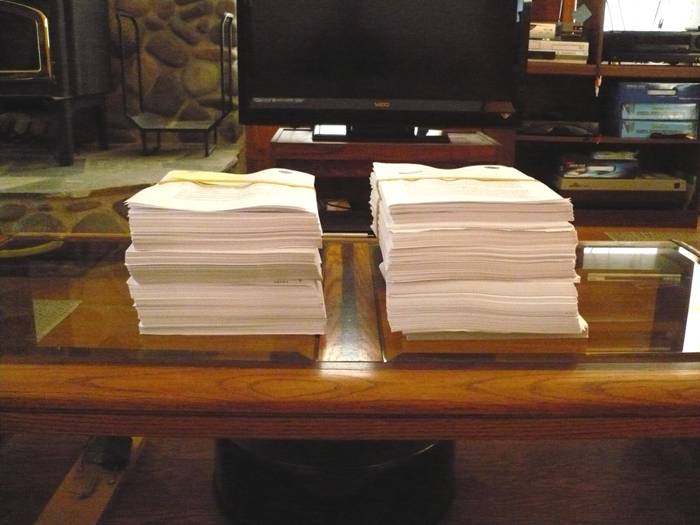
According to NASA there are about 4,000 pages of documents.
NASA originally said that only 100 pages of documents were being withheld.
They are not in any particular order. There is no index. There are many duplicates. Although the pages are numbered the numbers are frequently illegible. There are gaps in the numbers indicating that sections were entirely withheld, usually in the most interesting parts. Is NASA really this disorganized?
The pages run from 00017 to 05605 indicating that around 1600 pages were entirely withheld. Many of the emails are redacted. Sometimes the entire body of the email is redacted under § 552 (b)(5) [Deliberative Process, etc.]. That is what this entire case is about. However, by providing the documents (such as they are) it probably means NASA does not have to provide a Vaughn Index or provide them to the Court for in-camera inspection (or appoint a Special Master to review them).
This places the entire burden on me. I might have to place all 4,000 pages in an Appendix for a Motion to Amend my Complaint.
The documents were in roughly equal sections, held together by what appear to be the secret (but long rumored to exist) Advanced Propulsion Unit Prototypes (APUPs) left over from a cancelled (but really, now black) project. I hope NASA has filed for patent protection for the APUPs lest someday someone knock on their door claiming to have invented them first. For a picture click here.
I have scanned all the documents and expect to post them here eventually.
December 22, 2009
I filed my MOTION FOR LEAVE TO FILE AMENDED COMPLAINT today.
This is for my Second Amended Complaint which is necessary because of the
documents NASA sent me.
see doc016.pdf
Motion For Leave to File Amended Complaint
see doc016-1.pdf Second
Amended Complaint
see doc016-2.pdf Appendix
Volume 1
see doc016-3.pdf Appendix
Volume 2_1
see doc016-4.pdf Appendix
Volume 2_2
see doc016-5.pdf Appendix
Volume 3
I have made an html version of the Second Amended Complaint for easy online
reading. The Pacer PDF is the controlling document.
Some people will be angry at NASA because of how they have acted.
Some people will be angry at me for shining a light on them.
December 23, 2009
I am posting the 4,000 or so pages I received from NASA on November 16.
In order to make the documents more manageable I have separated them into
volumes. Sometime I separated them at a natural break in the material.
Sometimes I had to separate them because of sheer size.
The following is not a complete index, just what caught my attention.
Click here for the index.
January 21, 2010 - Status Report
Defendant's Motion to Dismiss (doc009.pdf) was still pending. Motions have to be
ruled on even when they are moot.
Notice of Electronic Filing
The following transaction was entered on 1/13/2010 at 2:56
PM PST and filed on 1/13/2010
Case Name: Margolin v. Bolden
Case Number: 3:09-cv-00421-LRH-VPC
Filer:
Document Number: 20 (No document attached)
Docket Text:
MINUTE ORDER IN CHAMBERS of
the Honorable Judge Larry R. Hicks on 1/13/2010. By Deputy Clerk: Rosemarie
Miller. RE: [9] MOTION to Dismiss. A telephonic status conference with regard
to defendant's motion to dismiss is scheduled on January 19, 2010 at 1:30 PM in
And it was worked out.
Notice of Electronic
Filing
The following transaction was entered on 1/19/2010 at 3:57 PM PST and filed on
1/19/2010
Case Name: Margolin v. Bolden
Case Number: 3:09-cv-00421-LRH-VPC
Filer:
Document Number: 21 (No document attached)
Docket Text:
MINUTES OF PROCEEDINGS -
Status Conference held on 1/19/2010 before Judge Larry R. Hicks. Crtrm Administrator: Rosemarie Miller; Pla Counsel: Jed Margolin, In
Pro Per; Def Counsel: Holly Vance; Court Reporter/FTR #: Donna
Davidson; Time of Hearing: 1:31 p.m. - 1:39 p.m.; Courtroom: 5.
Court convenes. The parties are present telephonically. The Court and the
parties confer with regard to the status of the pending Motion to Dismiss [9]
filed by defendants. With no objection by either party, IT IS ORDERED that the
Motion to Dismiss is considered moot and is dismissed without prejudice to
renew. Court adjourns. (Copies have been distributed by NEF - RM)
After the Status Conference on January 19 I had a nice conversation with Assistant U.S. Attorney Holly Vance. Afterwards I filed WAIVER OF SERVICE BY DEFENDANTS OF PLAINTIFF’S SECOND AMENDED COMPLAINT.
See doc022.pdf Waiver of Service by Defendants of Plaintiff's Second Amended Complaint
On March 1, 2010 I received DEFENDANTS’ MOTION TO DISMISS.
COME NOW Defendants National Aeronautics and Space Administration (“NASA”) and NASA Administrator Charles F. Bolden (“Bolden”) and move to dismiss Bolden from this action. This motion is made pursuant to Fed. R. Civ. Proc. 12(b)(1).
See doc023.pdf
This was followed shortly afterwards by
a MINUTE ORDER IN CHAMBERS REGARDING THE REQUIREMENTS OF Klingele v. Eikenberry
and Rand v. Rowland.
See doc024.pdf
The requirements of Klingele
v. Eikenberry and Rand v. Rowland are that if the
Motion to Dismiss contains evidence, it must also be treated as a Motion for
Summary Judgment.
On March 5, I filed a RESPONSE TO MINUTE ORDER IN CHAMBERS REGARDING THE
REQUIREMENTS OF Klingele v. Eikenberry and Rand v. Rowland (#24), where I
said:
Defendants' Motion to Dismiss raised only a legal issue – a jurisdictional challenge; the motion did not include the submission of any evidence. Therefore, it should not be considered a Motion for Summary Judgment.
See doc025.pdf
I also filed NON-OPPOSITION TO DEFENDANTS’
MOTION TO DISMISS BOLDEN (#23):
While Margolin continues to
believe that the Head of a Federal Agency, in his or her official capacity as
the Head of that Agency, is the proper party to name as the Defendant in any
action against the Agency as a way to emphasize that the people of an Agency
are the Agency, and that Agencies should not be allowed to be faceless, Margolin does not oppose Defendants’ Motion to
Dismiss Charles F. Bolden, in his official capacity as Administrator, National
Aeronautics and Space Administration, from this action (#23).
This leaves the National Aeronautics and Space Administration as the remaining
Defendant.
See doc026.pdf
The reason I am not fighting to keep General Bolden in
the case is because that is not what this case is about. It's about how NASA
treats Independent Inventors.
I discussed what an agency is in doc011-1.pdf
(Memo of Opposition) and doc011-2.pdf
(Memo of Opposition Appendix).
This thing about having to name the agency and not the Head of the
agency in a Freedom of Information Act action is a trap for the inexperienced.
Now I know better.
March 10, 2010
The 4,000 (or so) pages of documents that NASA sent me in November 2009 show
that after I gave NASA a 90 day extension to respond to my FOIA Request in July
2008 they spent some of it getting Court documents in the following lawsuit:
|
UNITED STATES
DISTRICT COURT vs. OPTIMA TECHNOLOGY GROUP, INC., ET AL. |
Why NASA thought the Court documents in this case were
relevant to my FOIA Request is a mystery. I had not asked NASA for the Court
documents. I didn't need to. I already had them because I had been a Defendant.
By the time NASA became interested in the case some of the documents had been
sealed but many were still available.
NASA chose to include only one material Court document in the 4,000 (or so)
pages they sent me: Universal Avionics Systems Corporation's SECOND AMENDED
COMPLAINT.
[This section revised 10/20/2010]:
Originally I posted all of the Pacer documents in the case so people could see
both sides. However, it has been brought to my attention that people aren't
looking at both sides. They are reading only UASC's
Second Amended Complaint, and that's not fair. They should see our side (I was
a Co-Defendant), so now I am being more selective.
1. See Amended Answer, Counterclaims, Cross-Claims, and Third
Party Claims of Optima Technology Group. If you want to know what the case was
really about see paragraph 93 on page 30. Click here.
(Our attorneys at Chandler & Udall, especially Ed Moomjian,
have a gift for turning a phrase.)
2. Note that the paragraph refers to "OTC". OTC is Optima
Technology Corporation, who tried to steal the patents. This is not Optima
Technology Group (referred to as "Optima"), whom I assigned the
patents to.
The Court set things straight in Document 31: (Click
here):
Final Judgment is entered
against Cross-Defendants Optima Technology Corporation, a California
corporation, and Optima Technology Corporation, a Nevada corporation, as
follows:
1. Optima Technology Corporation has no interest in U.S. Patents Nos. 5,566,073
and 5,904,724 (“the Patents”) or the Durable Power of Attorney from
Jed Margolin dated July 20, 2004 (“the Power of
Attorney”);
2. The Assignment Optima Technology Corporation filed with the USPTO is forged,
invalid, void, of no force and effect, and is hereby struck from the records of
the USPTO;
3. The USPTO is to correct its records with respect to any claim by Optima
Technology Corporation to the Patents and/or the Power of Attorney; and
4. OTC is hereby enjoined from asserting further rights or interests in the
Patents and/or Power of Attorney; and
5. There is no just reason to delay entry of final judgment as to Optima
Technology Corporation under Federal Rule of Civil Procedure 54(b).
DATED this 18th day of August, 2008.
One of the threads that run through my FOIA case with NASA is that they
continue to assert that Optima Technology Corporation owns the patents, in
defiance of the Court's order.
3. The UASC case opened a new chapter in TomCat
history. Click here.
March 12, 2010
In view of my Non-Opposition (doc026) to
Defendants' Motion to Dismiss Bolden as a Defendant (doc023)
their Motion to Dismiss Bolden as a Defendant was granted.
That leaves NASA as the Defendant.
In other news:
I filed another Freedom of Information Act Request with NASA in December. They
tried to ignore it but I was persistent.
They eventually responded.
Their response was woefully inadequate so I filed an Appeal with NASA.
I mailed it on Tuesday (March 9) and it was delivered yesterday (Thursday).
The (second) FOIA Request is not directly related to the current lawsuit, but
it is related to how NASA treats Independent Inventors.
If it becomes necessary to sue NASA over this second FOIA Request I will
probably blog it separately to avoid confusion. Since the Appeal will be
decided by the same people who decided not to send me any material documents in
response to my FOIA Request, a second lawsuit is likely.
April 21, 2010
Filed March 19, 2010
Stipulated Schedule For Filing Answer and Dispositive
Motions
Filed March 23, 2010
Ordered - Stipulated Schedule For Filing Answer
and Dispositive Motions
Filed April 12, 2010
NASA's Answer to Second Amended Complaint
I have converted it to html to make it easier to read online:
I have created an html file that matches the Answers to the paragraphs in my
Second Amended Complaint. I have made a substantial effort to accurately match
the sections in the paragraphs to the sections in the Second Amended Complaint.
Here are some of the items in NASA's Answer that jump out at me:
1.
My good friend Jan S. McNutt (NASA attorney) has left
NASA.
As a result, he does not have to cooperate with the NASA Inspector General if
the Inspector General wanted to ask him some questions.
Does anyone know where Jan went?
I would also like to know where Alan J. Kennedy went after he left NASA.
2. The Borda Report asserted that:
“… numerous pieces of evidence were uncovered which would constitute anticipatory prior knowledge and prior art that was never considered by the U.S. Patent and Trademark Office during the prosecution of the application which matured into Patent No. 5,904,724.”
and threatened:
“… NASA reserves the right to introduce such evidence of invalidity in an appropriate venue, should the same become necessary.”
NASA now admits there is no patent report.
From NASA Answer Paragraph 16:
"Defendant denies the allegations contained at page 7, lines 4-5 of this paragraph and denies that any document that could constitute a “Borda Patent Report” was ever prepared, much less withheld."
Simplified: In order to invalidate a patent using prior art you have to show
that all of elements in a claim are present in the prior art. You are allowed
to use more than one reference if you can show it would be obvious to
combine the references. If you knock out all of the claims in a patent,
then you have invalidated the patent.
That is what a patent report is. If you don't have that, then you are full of
beans. NASA is full of beans.
3. NASA admits that it does not know what Synthetic Vision is.
4. NASA's Answer ends with:
WHEREFORE, Defendant prays for judgment as follows:
1. That judgement be entered
in favor of Defendant and against Plaintiff;
2. That Plaintiff take nothing by way of his complaint;
3. For costs of suit; and
4. For such other relief as may be proper.
NASA wants me to pay their legal expenses.
Is there any precedent for this in a Freedom of Information Act lawsuit, or for
any other Government lawsuit?
The Government already has an unlimited amount of money to spend to defend
NASA. (They get it from you and me.)
I don't see anything in the Freedom of Information Act that tells you if you
sue the Government and lose, then you will probably lose everything you have.
April 23, 2010
Yesterday, April 22, I received NASA's decision on my appeal of their response
to my second FOIA Request.
Their response to my Second FOIA Request was woefully inadequate so I filed an
Appeal with NASA.
They denied my Appeal.
I used OCR to convert it to html.
The decision was made by Thomas S. Luedtke ("Luedtke"), NASA Assistant Administrator for Agency
Operations.
Luedtke's name has come up before.
1. He denied my Appeal in my First FOIA Request but only after I filed
the current lawsuit.
2. He denied the Associated Press's FOIA Request for the results of a
national survey of pilots that found safety problems like near collisions
and runway interference occur far more frequently than the government
previously recognized. NASA had withheld the report in order to avoid upsetting
air travelers. I discussed this previously. Click Here.
At the end of that section I asked:
The question is, what did NASA learn from this fiasco?
1. Did they learn not to withhold information?
2. Did they learn to withhold information better?
3. Did they develop a bunker mentality?
The answers are definitely: No,
Yes, Yes.
Here are some of the highlights from Luedtke's
denial of my appeal in my Second FOIA Request.
1. NASA does not know what an Independent Inventor is.
NASA: There are no responsive records to items 3, 4, 5 and 8 because the search revealed no Agency records which refer to Agency use of the category "Independent Inventors."
When I talked to Alan J. Kennedy in June 2003 he knew what an Independent
Inventor is. (He had some very unkind things to say about us.) Mr. Kennedy has
since retired from NASA and has apparently taken that knowledge with him.
2. NASA does not know how many patent claims filed against it were
affirmed or denied.
NASA: Items 2 and 6 request the number of patent claims affirmed and denied by NASA respectively during the relevant period. As you note in your appeal, the log provided as item 1 is incomplete as to the disposition of the claims identified therein. The log was provided as it is maintained by the Agency. Because the Agency is not required to create new records in response a FOIA request, there are no Agency records which enumerate the information requested in items 2 and 6.
3. NASA does not know how many times it has been sued for patent
infringement.
NASA: There are no responsive records to item 7 because the search revealed no records which enumerate Court actions resulting from claims for patent infringement denied by NASA.
NASA should remember at least this one involving Boeing: http://www.uscfc.uscourts.gov/sites/default/files/ALLEGRA.Boeing040209.pdf
In The
THE BOEING COMPANY, Plaintiff, v. THE UNITED STATES, Defendant.
Trial; 28 U.S.C. § 1498; Damages owing to infringement of patent by NASA in
developing super lightweight external tank for Space Shuttle; Hypothetical
licensing agreement; Georgia Pacific factors; Reasonable royalty
rate; Impact of prior licensing agreements involving same patent; Royalty
base; Entire market value rule; Reliance on prior licensing agreements;
Prejudgment interest; Compounding of interest.
NASA lost.
4. NASA does not have a written procedure for administratively reviewing
a claim of patent infringement. They had one at one time but now they can't
find it.
NASA: Although in item 9 you failed to identify a particular GAO report, NASA Headquarters Office of General Counsel identified GAO Administrative Review B-285211, NASA's Administrative Review of a Patent Infringement Claim, dated August 8, 2000, which states that the GAO reviewed NASA's procedures for administratively reviewing a claim of patent infringement as attached to a September 29, 1987 letter. As confirmed by the document quoted at page 13 of your appeal, the NASA Headquarters Office of General Counsel did not have a copy of the attachment as of January, 2009. The search revealed that no copy of the attachment has been located since that time.
Apparently, if you file a claim against NASA for patent infringement the NASA
attorney handling your case acts according to his/her own whims. Or perhaps
there is a short unwritten policy that just says, "Deny the
Claim."
Also, when I filed my Second FOIA Request I attached the GAO Report. When NASA
refused to read it I sent it again. Thinking that perhaps NASA's mail servers
reject emails with attachments I sent it without the attachment. I included the
GAO Report “NASA’s Administrative Review of a Patent Infringement
Claim, August 8, 2000 in the Appendix to my Appeal.
NASA seems to lose lots of things. For example, in my article NASA’s
Continuing Lack of Accounting Controls (http://www.jmargolin.com/nasa/actn/nasa_accounting.htm)
we learn that in 2008 NASA was unable to account for capital assets with
an acquisition cost of about $32 Billion (with a net value of about $18.6
Billion).
5. The above referenced GAO Report referred to NASA's Director of Patent
Infringement so I asked who that person is. It appears that either NASA doesn't
have one or he is practicing how not to be seen.
NASA: There are no responsive records to item 10. In your appeal, you make a new request and state that if no one has the title of Director of the Infringement Division, you request the identity of the person who performs that function. The current functional structure of the Commercial and Intellectual Property Law Practice Group in the NASA Headquarters Office of General Counsel is available at http://www.nasa.gov/offices/ogc/commercial/index.html.
This is what that link produces:
The Commercial and Intellectual
Property Law Practice Group is responsible for providing legal advice in
support of NASA's commercial, commercialization and intellectual property
related programs. The Practice Group provides functional leadership in
negotiating, drafting, and interpreting NASA Space Act Agreements, and
partnering arrangements with commercial organizations. It also develops,
coordinates, implements, and administers NASA's Intellectual Property Program,
and provides functional leadership to all Offices of Chief Counsel at NASA
Centers in the areas of patents, copyrights, trade secrets, technical
data in contracts, grants, cooperative agreements, and the distribution of
computer software. The Practice Group also provides legal advice and counsel
involving issues related to commercialization of NASA activities, and
coordinates such matters in the international arena with the International Law
Practice Group.
Space Act Agreements are authorized by the National Aeronautics and Space
Administration Act of 1958, a Federal statute. The Practice Group has primary
responsibility for the NASA policy implementing this unique authority, as well
as for maintenance of the NASA Space Act Agreements Manual. Space Act
Agreements include mutually beneficial activities that further NASA missions
where there are no exchange of funds ("non-reimbursable" agreements)
or undertakings for the benefit of the non-NASA party, and where NASA costs are
borne by the non-NASA party ("reimbursable" agreements).
The Intellectual Property division of the Practice Group performs under the
direct cognizance of the Agency Counsel for Intellectual Property. It provides
functional guidance with respect to patent solicitation to ensure application
of uniform criteria Agency-wide relative to invention reporting, patent
application preparation, and filing and conduct of proceedings before the
United States Patent and Trademark Office. In addition, the division develops
and supports the implementation of policies and procedures related to patent
and copyright licensing so that uniform criteria are applied NASA-wide and to
ensure the maximum beneficial use of patented and copyrighted technology. The
Intellectual Property division supports Department of Justice litigation
efforts, licensing, handling infringement-related administrative claims, review
of Freedom of Information Act requests concerning technical data and computer
software, trademark applications, and handles negotiation and review of
intellectual property provisions for Space Act Agreements.
|
Associate General Counsel (Acting) |
Courtney Graham |
|
Agency Lead IP Attorney |
Gary G. Borda |
|
Legal Technician: |
Kathy Bayer |
|
Attorney Staff: |
Jan McNutt |
For more information about the Office of the General Counsel Organization
visit: › OGC Organization
OGC Disclaimer: The materials within this website do not constitute legal
advice. For details read our disclaimer.
I don't see anyone with the title Director of the Infringement Division or
anyone who might perform that function.
I don't see an Infringement Division.
Luedtke blew me off.
And note that the page still lists Jan McNutt as Attorney Staff even though Mr.
McNutt has left NASA.
Either NASA's OGC practices incredibly sloppy record-keeping or they are lying.
June 9, 2010
I filed my Motion For Summary Judgment and
Memorandum of Points and Authorities today.
Motion For Summary Judgment and
Memorandum of Points and Authorities (doc032.pdf)
Appendix Volume 1 - Part 1 (doc032-1.pdf)
Appendix Volume 1 - Part 2 (doc032-2.pdf)
Appendix Volume 2 (doc033.pdf)
Appendix Volume 3 (doc034.pdf)
Appendix Volume 4 (doc035.pdf)
Appendix Volume 5 (doc036.pdf)
Appendix Volume 6 (doc037.pdf)
Appendix Volume 7 (doc038.pdf)
If you are pressed for time, these are the documents to read in the case. At least for now.
For an html version of the Motion For Summary
Judgment and Memorandum of Points and Authorities click
here.
There are some formatting differences from the PDF version. The html
file was made from my original MS Word documents. Also, the PDF
version is the Pacer version.
September 9, 2010
On September 7 Holly filed her Opposition to Motion for Summary Judgment and
Cross-Motion for Summary Judgment. There are a lot of documents.
Opposition
to Motion for Summary Judgment and Cross-Motion for Summary Judgment
(doc042.pdf)
I have used OCR to convert it to text for this
html version. I have formatted it for online reading. (doc042.htm)
Declaration of Courtney B. Graham (doc042-1.pdf)
I have used OCR to convert it to text for this
html version. I have formatted it for online reading (doc042-1.htm)
List of Exhibits for Graham Declaration (doc043.pdf)
Exhibit I - Margolin FOIA
Withheld Index (doc044.pdf)
Exhibit J - Exhibit L (doc045.pdf)
There is a duplicate set of documents. I was told it was because Holly combined
her Opposition to Motion for Summary Judgment with her Cross-Motion
for Summary Judgment and the Court's system has separate categories for
each type of document.
Opposition to Motion for Summary
Judgment and Cross-Motion for Summary Judgment (doc046.pdf)
Declaration of Courtney B. Graham (doc046-1.pdf)
List of Exhibits for Graham Declaration
(doc046-2.pdf)
Exhibit I - Margolin FOIA
Withheld Index (doc046-3.pdf)
Exhibit J - Exhibit L (doc046-4.pdf)
Exhibit I (Margolin FOIA Withheld Index) is
especially interesting. I am amazed by how much time and effort NASA has spent
on this over the years. This must have cost NASA a bundle. They probably could
have bought the patents from me in 2003 for less than what they have spent
trying to destroy the patents (and me). But they never asked how much I wanted
for the patents.
Now that I no longer own the patents, that ship has sailed. (Or, maybe, that
rocket has launched.)
September 19, 2010
NASA's Exhibit I - Margolin
FOIA Withheld Index (doc044.pdf) is a fascinating document.
Unfortunately, it is a scanned document (image only) so it is not
text-searchable. To remedy this I have used OCR to convert it to text.
Then I made a MS Word document. From that I made an html file and a PDF file.
This PDF file is different from the PDF that NASA filed because mine is
text-searchable. There may be OCR errors that have escaped my proofreading, so
refer to the original document before quoting. Why did I spend time on this? It
shows how NASA treats Independent Inventors.
Errors in the original document have been left uncorrected. ("administrative" is sometimes spelled "admininstrative" and "forward"
is sometimes spelled "foward")
Exhibit I - Margolin FOIA Withheld
Index: doc044_ocr.htm
Exhibit I - Margolin FOIA Withheld Index: doc044_ocr.pdf
September 21, 2010
For the cases cited in NASA's Opposition to
Motion for Summary Judgment and Cross-Motion for Summary Judgment Click Here.
October 4, 2010
Today I filed my Reply to NASA's Opposition to my
Motion for Summary Judgment and my Opposition to NASA's Cross-Motion for Summary
Judgment.
My Reply to NASA's Opposition to
my Motion for Summary Judgment (doc049.pdf)
Appendix (doc049-1.pdf)
My Opposition to NASA's Cross-Motion for Summary
Judgment (doc050.pdf)
Appendix (doc050-1.pdf)
I think I'll take a nap now.
Wake me up for Thanksgiving.
November 9, 2010
Holly woke me up early.
On November 1, 2010 she filed the following:
[NASA] Motion to Strike
I converted it to html:
GOVERNMENT'S REPLY
I converted it to html:
Exhibits for doc052:
On November 8, 2010 I filed the following:
Motion Requesting Leave For Excess Pages
Opposition to Motion to Strike and Motion Requesting Leave to File Declaration
Motion to Strike Government's Reply
I expect I will have more to say about it sometime.
November 24, 2010
On November 9, 2010 my Motion Requesting Leave for Excess Pages (#53) was
granted.
Holly filed her REPLY TO OPPOSITION TO MOTION TO STRIKE AND OPPOSITION TO
MOTION REQUESTING LEAVE TO FILE DECLARATION on November 16.
She said some very harsh things, so I have converted it to html using OCR
to make it text searchable.
November 26, 2010
Holly filed her OPPOSITION TO MOTION TO STRIKE (#55) today.
The document is already text-searchable because it was produced by Corel PDF
Engine Version 1.14.0.755 .
Several of her previous filings were produced by scanning the documents using a
Canon iR8070. See, for example, Document 52.
To make that document text-searchable I had to use OCR and do
considerable proof-reading.
December 3, 2010
On November 30, 2010 Holly filed a Notice of Errata
to correct what she described as an error in Document 59 (Opposition to
Motion to Strike).
I don't see anything in the Federal Rules of Civil Procedure or the Local Rules
that permit such a thing.
It must be an Undocumented Privilege.
I wonder if there are more Undocumented Privileges.
In any event, today I filed my Reply to Holly's Opposition to my Motion to
Strike.
April 21, 2011
It's been awhile since my last update and several
things have happened.
Basicially, I lost.
From the Court's decision:
IV. Conclusion
For the foregoing reasons, the court concludes that NASA is entitled to
judgment as a matter of law as to the withholding and redaction of information
under Section 552(b) of the Freedom of Information Act, with the exception of
the document identified at line #252 of the Index of withheld documents. As to
that document, NASA has failed to carry its burden of establishing the
applicability of a statutory exemption from disclosure, and Margolin
is therefore entitled to its release.
IT IS THEREFORE ORDERED that Defendant’s Motion to Strike (#51) is
DENIED.
IT IS FURTHER ORDERED that Plaintiff’s Motion for Leave to File
Declaration (#54) is GRANTED.
IT IS FURTHER ORDERED that Plaintiff’s Motion to Strike (#55) is DENIED.
IT IS FURTHER ORDERED that Plaintiff’s Motion for Summary Judgment (#32)
is GRANTED in part and DENIED in part as specified in this order.
NASA's Motion to Strike (#51) was denied.
My Motion to Strike (#55) was denied.
My Motion for leave to file the required Declaration (#55) was granted.
My Motion For Summary Judgment (#32) was granted in
part and denied in part. Actually it was totally denied except for one
document, a document that appears to be irrelevent
and NASA asserts was included by mistake..
The Court ruled that NASA was entitled to redact and withhold all the other
documents.
Here is the Court's decision (March 31, 2011):
And the Judgment Sheet:
But, it's not over.
There is the matter of the 4,000 pages of documents that NASA sent me in
November 2009.
They would not have sent me the documents if it hadn't been for this lawsuit.
I think I substantially prevailed.
So I filed a Motion For Costs (April 3, 2011). It's
not for much, just things like the filing fee, postage, copying costs, PACER
costs, and driving costs to go to the Nevada Supreme Court Law Library in
Carson City to read the Franklin book Guidebook to the Freedom of
Information and Privacy Acts 2d Ed; Justin D. Franklin and Robert F.
Bouchard (Editors), Thomson Reuters. It's a great book but too expensive to buy
from Thomson Reuters http://west.thomson.com/productdetail/2525/13514269/productdetail.aspx
($366). There are some old editions available on the Web, such as
the 1986 edition for $20.90, but I don't advise using a 25 year old law book
unless you are a Law Historian..
Another reason I needed to go to the Nevada Supreme Court Law Library so
often was to look up all of the unpublished (and mostly old) cases
that Holly is so fond of citing.
I don't get to charge for my time.
My main argument for asking for costs is that:
J. The approximately 4,000 pages of documents, as well as NASA’s behavior during this lawsuit, give a valuable look into how Government (especially NASA) works. And that is the purpose of the Freedom of Information Act.
Holly doesn't agree, so she filed RESPONSE TO MOTION FOR COSTS (#64) (April 20,
2011)
I have converted it to html:
Since Holly opposed my Motion For Costs I think it
should have been called Opposition to Motion For Costs, but she called it a
Response.
That means that my Response will have to be called "Response to NASA's
Response to Motion For Costs" which is awkward
phrasing.
And, we have another affidavit by Courtney Graham.
I will be filing my "Response to NASA's Response to Motion For Costs" soon.
BTW, on April 20, 2011 a Google search for NASA FOIA lawsuit puts this
article/blog at #12 on the hit list. For Google hits on April 20 click here. I must be doing
something right.
April 25, 2011
Today I filed my Response to NASA's Response to
My Motion For Costs
It is a microcosm of the case so I will reproduce most of it here.
.start
Argument
A. The issue of whether or not Margolin
has substantially prevailed in this case is not about the single two-page
letter (“Calvert Letter”) that NASA was ordered to produce. (#65,
page 2, lines 4-11 and #62 page 16, lines 11-23). Nonetheless, the Calvert
Letter (apparently reproduced in Graham Declaration #65-1) is probative. In it
NASA tells Calvert (#65-1 page 6):
(1) Prior art has been brought to my attention that was not reported to the United States Patent and Trademark Office by you.
However, NASA fails to say how the prior art is relevant. NASA doesn’t
even name it. This is the same tactic used by Borda
(#19-1 page 51):
“… numerous pieces of evidence were uncovered which would constitute anticipatory prior knowledge and prior art that was never considered by the U.S. Patent and Trademark Office during the prosecution of the application which matured into Patent No. 5,904,724.”
Borda’s threat is, however, more explicit (
“… NASA reserves the right to introduce such evidence of invalidity in an appropriate venue, should the same become necessary.”
It is the beginning of a pattern showing how NASA deals with independent
inventors.
Indeed, in the Graham Declaration (#65-1 ¶5) she states:
“The December 4, 2002 draft letter to W. Calvert was provided by Ms. Bayer to Mr. McNutt to use as a template in drafting the final determination in Case I-222, the claim that was the subject of Plaintiff’s FOIA request.”
Thus, NASA’s template for responding to independent inventors’
claims for compensation contain the perfunctory statement that, “Prior
art has been brought to my attention that was not reported to the United States
Patent and Trademark Office by you.”
An allegation that prior art exists can damage a patent’s value,
especially when:
1. The allegation is made by NASA;
2. The allegation fails to provide even the name of the alleged prior
art.
This is not only bad faith on NASA’s part, it is reprehensible and
repugnant.
B. The issue of whether or not Margolin
has substantially prevailed in this case is not about the Court’s
decision to allow NASA to withhold the documents they have withheld (for
example, #62 page 16, lines 2 - 10). The issue of whether or not Margolin has substantially prevailed in this case is about
the approximately 4,000 pages of documents that NASA voluntarily produced in
November 2009, and whether the results of this case have given the public a
greater understanding of how their Government works.
1. 5 U.S.C. 552 § (a)(4)(E)
states:
(i) The court may assess against
the
(ii) For purposes of this subparagraph, a complainant has substantially
prevailed if the complainant has obtained relief through either -
(I) a judicial order, or an
enforceable written agreement or consent decree; or
(II) a voluntary or unilateral change in position by the agency, if the
complainant's claim is not insubstantial.
The production of the approximately 4,000 pages of documents that NASA produced
represents a substantial change in NASA’s position.
a. Margolin filed a claim for
compensation in June 2003. (See #62, page 1, lines 23-25).
b. NASA did not respond to the claim until after Margolin filed a FOIA request. (Margolin
filed the FOIA request in June 2008 - See #62, page 3, lines 10 - 14; NASA did
not respond to Margolin’s claim until May 2009
- See #62, page 3, line 15.)
c. NASA did not respond to Margolin’s FOIA administrative appeal until after he
filed the present action. (Margolin filed his
administrative appeal with NASA in June 2009 - See #62, page 4, lines 25
- 26; He filed the present action on July 31, 2009 - See #1, page 1; NASA
responded to Margolin’s administrative appeal
on August 5, 2009 - See #62, page 4, lines 11 -12.)
d. NASA’s production of the approximately 4,000
pages of documents was a voluntary and unilateral change in NASA’s
position. Margolin was surprised that NASA produced
the documents without an order from this Court.
NASA has failed to address the issue of the approximately 4,000 pages of
documents that it voluntarily and unilaterally produced. Instead they have
tried to make the issue about the Calvert Letter.
2. The results of this case have given the public a
greater understanding of how their Government works,
both by the documents that NASA produced and how NASA has conducted themselves
during this case.
a.
The public has learned that NASA’s standard answer when independent
inventors ask NASA for compensation for infringing their patent includes: (i) NASA does not infringe; and (ii) NASA has found prior
art that was not reported to the United States Patent and Trademark Office by
you (but they refuse to even name the alleged prior art).
b. The public has learned that NASA does not take FOIA
requests from independent inventors seriously until an action is brought
against NASA. From Graham Declaration #42-1 ¶¶ 27,28:
27. On August 12,
2009, I issued a notice to preserve evidence relevant to the lawsuit to
28. I received over 5600 pages of
documents from the NASA Field Centers in response to my request. Many documents
were duplicates because the NASA personnel investigating the claims consulted
closely with one another by e-mail and telephone while reviewing Case Number
I-222, so e-mails and documents were received by multiple people
simultaneously.
While many of the documents were duplicates, many were not. These documents
were not given to Margolin as a result of his FOIA
request. NASA did not even search for them until he filed the present action.
c.
One of the documents among the approximately 4,000 pages of documents
that NASA produced is an email from NASA attorney Robert Rotella
to Courtney B. Graham dated May 5, 2009. In it, Margolin’s
claim was officially denied. By an interesting coincidence the email also
contains NASA’s decision to wiggle out of their promise to abide by the
results of a contest for naming the Node 3 module of ISS. (The comedic
political commentator Stephen Colbert had asked his viewers to vote for his
name, and they did. He won the contest.) The email is reproduced as Exhibit 1.
The part about Stephen Colbert is as follows:
1) Node 3 module of ISS online naming contest: Drafted set of rules and entry conditions for participants; the most significant was that the agency was not bound to accept the results of the online voting which avoided having to name Node 3 after Stephen Colbert, who encouraged viewers to nominate him.
The Colbert Report has a devoted following. The public would not know the
details about NASA’s bad faith toward Stephen Colbert (and the members of
the public who voted for him) without the present lawsuit.
C. NASA cites Young v. Dir., No. 92-2561, 1993
WL 305970, at *2 (4th Cir. Aug. 10, 1993). (#65, page 2, line 15).
NASA’s Counsel has misrepresented Young by taking her quote
out of context. The full context is as follows (Young ¶¶10-12):
10 Under 5 U.S.C. Sec.
552a(4)(E) of the FOIA, a district court "may assess against the
11
12 Even if a plaintiff substantially
prevails, however, a district court may nevertheless, in its discretion, deny
the fees. The exercise of this discretion is appropriate if the award of
attorney's fees "will [not] encourage fulfillment of the purposes of
FOIA." Nix v. United States, 572 F.2d 998, 1007 (4th Cir. 1978) (holding
that where suit is brought to benefit the plaintiff's own interests, as opposed
to being for the public benefit, a district court could not be said to have
abused its discretion in denying fees).
{Emphasis added}
The issues are:
1. The determination of whether a
plaintiff has substantially prevailed is largely a question of causation, that
is, did the litigation cause the agency's surrender of that information?
2. Whether Margolin’s suit
was brought to benefit his own interests, as opposed to the public’s
interest.
a. As shown supra, NASA’s production of the
approximately 4,000 was voluntary and unilateral and was caused by the present
lawsuit.
b. Now we consider whether Margolin’s
suit was brought to benefit his own interests, as opposed to the public
interest. NASA makes the statement (#65, page 3, lines 13 -15):
Applying the second and third factors here, Plaintiff clearly had an incentive to litigate this FOIA action to gather information related to the investigation of his patent infringement claim.
When Margolin approached NASA in 2003 it was to offer
to sell the patents to NASA. (See Exhibit 2, which is a reproduction of the
first five pages of the claim information that Margolin
provided in June 2003. The full document was reproduced in #19-1 as Exhibit 1.)
NASA told him he could either offer to sell them the patents or he could file a
claim for compensation but he could not do both. (
When the Media gets an exemption of fees for its FOIA requests it is recognized
that reporters receive a personal benefit. They get paid to write stories using
the FOIA material. Their employers are frequently profit-making organizations.
In Davy v. CIA, 550 F.3d 1155, 1159 (D.C. Cir. 2008) William Davy filed
a FOIA request with the CIA to obtain information about individuals allegedly
involved in President Kennedy's assassination. At least one of the
requested documents was not previously available to the public. (See Davy at 1159.) Davy had planned to use that
information in his research to write a book. (See Davy
at 1161.) From Davy at 1160:
First, the mere intention to publish a book does not necessarily mean that the nature of the plaintiff's interest is "purely commercial." See S. REP. No. 93-854, at 19. Surely every journalist or scholar may hope to earn a living plying his or her trade, but that alone cannot be sufficient to preclude an award of attorney's fees under FOIA. "If newspapers and television news shows had to show the absence of commercial interests before they could win attorney's fees in FOIA cases, very few, if any, would ever prevail." Tax Analysts, 965 F.2d at 1096. Yet their activities often aim to ferret out and make public worthwhile, previously unknown government information — precisely the activity that FOIA's fees provision seeks to promote. Furthermore, a conclusion that using information obtained under FOIA in connection with research for purposes of writing a book necessarily makes fees unavailable is inconsistent with the distinction that underlies this court's analysis of the relevant factors. Cf. Nationwide, 559 F.2d at 713 (discussing Goldstein v. Levi, 415 F.Supp. 303, 305 (D.D.C.1976)).
Note that NASA did not ask Margolin for any fees
regarding his FOIA request. The issue of fees never came up during the FOIA
request that led to the present action.
Margolin is not planning to write a book. He has been
blogging this case on his Web site since the beginning of the case. The
article/blog is entitled How NASA Treats Independent Inventors. In it Margolin has posted:
1. All of the Court documents;
2. Margolin’s difficulties as a newbie;
3. Margolin’s difficulties getting NASA to accept mail that they do not want to
receive;
4. Some commentary on the process;
5. A discussion of stare decisis;
6. Copies of most of the cases cited by both
parties and links to where he got the cases so others can find them;
7. All of the approximately 4,000 pages of
documents that NASA produced;
8. The results of Margolin’s
second FOIA request to NASA where he asked for specific documents relating to
NASA’s treatment of independent inventors.
9. The results of Margolin’s third FOIA
request which NASA has completely ignored.
See Exhibit 3 for the most current version of Margolin’s
blog/article as of April 24, 2011.
On April 20, 2011 Margolin did a Google search for
the terms: NASA FOIA lawsuit.
Google reported about 133,000 hits. Margolin’s
blog/article was ranked number 12 (or 13 if you count the videos separately).
See Exhibit 4. (Google ranking is based on several factors. One of them is how
often the Web page is clicked on by Googlers, i.e.
its popularity.)
People are reading Margolin’s blog/article. A
printout of Margolin’s server logs just for the
blog/article (which started in September 2009) would require more than 500
pages. (To save space Margolin will refrain from
submitting it as an Appendix here.)
Margolin’s Web site is non-commercial. He does
not make money from people going to his Web site.
NASA knew that Margolin was going to blog the case.
He told them he was going to blog the case in a fax to NASA Acting
Administrator Scolese in April 2009. See Exhibit 5
last paragraph, also reproduced as Exhibit 8 in #19-1. NASA has
periodically visited Margolin’s Web site and
read Margolin’s blog. They have also read some
of Margolin’s other articles. See Appendix 6
for NASA’s visits to Margolin’s Web site
from January 1, 2011 to April 20, 2011. (To save space Margolin
has deleted hits to graphic images.)
Thus, whatever personal benefit Margolin received
from the present case is the same personal benefit that journalists receive for
their work.
D. NASA makes the argument (#65, page 2, lines 10-11):
As Plaintiff himself readily concedes, he “basically lost this lawsuit.” (#64 at p. 3). Under the circumstances, he is not entitled to costs.
NASA has taken the quote out of context by omitting the second part of the
sentence (#64, page 3, lines 17-18):
Thus, although Margolin basically lost this lawsuit, at the same time he substantially prevailed and deserves his costs.
That sentence is a summary of the preceding ten paragraphs in #64.
E. NASA’s citation of Read v. FAA, 252 F.
Supp. 2d 1108, 1110-11 (W.D. Wash. 2003) is relevant, but not the way they
intended it to be. (#65, page 3, lines 16-19):
As for the fourth factor, there is no evidence that NASA acted in bad faith in withholding the two-page letter. See Read v. FAA, 252 F. Supp. 2d 1108, 1110-11 (W.D. Wash. 2003) (“[r]ecalcitrant and obdurate behavior ‘can make the last factor dispositive without consideration of any of the other factors.’”).
NASA’s reference to the two-page letter is to the Calvert Letter, supra.
And, rather than being inconsequential, it shows the pattern of how NASA deals
with independent inventors. But, as shown supra, NASA’s
recalcitrant and obdurate behavior is that NASA does not take FOIA requests
from independent inventors seriously until an action is brought against NASA.
F. In arguing the Fourth Point NASA also cites Church of Scientology v. USPS, 700 F.2d 486, 492 (9th Cir. 1983) “whether the
government’s withholding had a reasonable basis in law.” (#65, page
2, lines 20-22).
The issue is not about the Calvert Letter. The issue is about the approximately
4,000 pages of responsive documents that NASA produced in November 2009,
approximately three months after the commencement of the present action.
NASA should have produced these documents in response to Margolin’s
FOIA request.
NASA’s withholding of these documents had no basis in law.
NASA’s withholding of these documents constitute
bad faith.
NASA’s withholding of these documents necessitated a large expenditure of
Margolin’s time and a modest expenditure of
money.
Margolin deserves his costs.
October 22, 2011
I have been tardy in updating this page. (I've been busy with other things.)
On 6/3/2011 the Court decided that I was entitled to my costs but only up to
the point where NASA had voluntarily produced the approximately 4,000 pages of
documents.
I think this part was unkind (Page 4, lines 2-8):
The court also finds, however, that Margolin is not entitled to costs of litigation after November 5, 2009, when NASA made its supplemental disclosures. As discussed above, Margolin’s continuation of litigation following that point was virtually fruitless, resulting in neither additional voluntary disclosures nor the court-ordered disclosure of any documents responsive to his FOIA request. Furthermore, the court finds Margolin’s voluminous filings to have been in substantial part immaterial to the FOIA issues before the court, unnecessarily voluminous even when material, and therefore wasteful and unworthy of compensation.
The Court continued:
IT IS THEREFORE ORDERED that within 14 days Margolin shall file an affidavit or declaration itemizing litigation costs incurred prior to November 5, 2009. NASA may file objections within 10 days thereafter.
See doc67.pdf
On 6/6/2011 I did that.
On 6/15/2011 NASA (Holly A. Vance) filed an objection to my costs, small as
they were. Her arguments were bogus and she did it in a particularly
mean-spirited way.
On 6/20/2011 I responded.
On 6/20/2011 I also filed a Motion requesting permission to continue using
electronic filing (CM/ECF).
One of Holly's objections was to my cost to drive down to the Courthouse to
file the case. She said I should have filed the case electronically.
However, while Special Order 109 requires attorneys to file electronically,
non-attorneys are not allowed to file electronically except by Motion. (See Special Order
109.)
You cannot file a Motion until you have filed a Complaint and, until you have permission
to file electronically, you have to file the Complaint (and other documents) on
paper. (I would guess that Holly's favorite movie is the classic 1970
movie Catch 22. See http://www.imdb.com/title/tt0065528/ and
http://en.wikipedia.org/wiki/Catch-22)
My request (#71) was Denied.
I filed both my Motion Requesting Permission to Continue to File Electronically
(#71) and my Response to NASA's Response (my #70) on 6/20/2011.
While my Request to Continue to File Electronically (#71) was denied on August
22, 2011, it is now October 22, 2011 and the Court has not ruled on my Costs
(#70).
As of today:
October 22, 2011 (continued)
It turns out that I am not the only one who has trouble getting NASA to produce
documents.
From http://www.spaceref.com/news/viewnews.html?id=1557
Senate Issues Subpoena to NASA for SLS Materials (Update)
· By Keith Cowing
· Posted Thursday, July 28, 2011
Keith's 11:00 am EDT note: Sources are reporting that the Senate Commerce Committee has finally made good on its threat and has issued a subpoena to NASA regarding materials related to the SLS decision. Prior to this several letters and a hearing were held to prompt NASA in this regard. No luck. Congress is more or less convinced that the decision regarding SLS design/architecture has already been made and they are using the tools at their disposal to force NASA/the White House to admit that this is indeed the case. Stay tuned.
December 7, 2011
On November 3, 2011 the Court decided that:
Upon review of the parties
submissions, the court sustains Defendant’s objections. The bill of costs
is otherwise unopposed.
IT IS THEREFORE ORDERED that costs are taxed in the amount of $525.06 and
included in the judgment.
IT IS SO ORDERED.
DATED this 3rd day of November, 2011.
See doc73.pdf .
In my Declaration of 6/6/2011 (doc68.pdf) I listed costs of $791.25 .
|
$350.00 |
|
|
$80.90 |
|
|
Travel (Driving and Parking) $0.55/mile as per IRS Rules |
$261.53 |
|
|
$47.78 |
|
|
Office Supplies |
$0.00 |
|
|
Pacer Charges |
$51.04 |
|
|
|
|
|
|
Total |
$791.25 |
The Court failed to state which costs they had disallowed (and why).
What am I going to do with my new-found wealth?
Nothing.
It has been 33 days since the Court ordered NASA to pay me $525.06 and NASA
hasn't paid me.
I will give NASA some more time. After all, they have 60 days to appeal the
$525.06 judgment to the 9th Circuit Court of Appeals. (The fee for a petition
for review is $450.)
After that I am thinking of registering the judgment with the U.S. District
Court for the Southern District of Florida, filing a Writ of Execution, and
having
February 6, 2012
On January 6, 2012 I sent NASA an email, part of which was to remind them that
they hadn't paid me. I sent it to several people at NASA, including Michael Wholley (General Counsel), Lori Garver
(Deputy Administrator), and Paul Martin (Inspector General).
I sent it using the “Request Read Receipt” feature of Windows
Mail. I received a Read Receipt from several recipients (including Mr.
Martin) but not from Mr. Wholley or Ms. Garver.
I did not receive a response from anyone.
So, today I filed a Motion to Compel NASA to disclose their assets in
2/6/2012 [Margolin]
Document 74 Motion to Compel
NASA to Disclose Assets in the State of
2/6/2012 [Margolin]
Document 75 Motion Requesting
NASA Be Held in Contempt. (Contains January 6 email to NASA)
February 25, 2012
On Wednesday February 22 NASA filed the following:
2/22/2012 [NASA]
Document 76 Response to Motion
to Compel NASA to Disclose Assets in the State of Nevada
Special Order 109: III. ELECTRONIC FILING, F. Form of Documents, 1.
PDF Format requires that:
All documents shall be filed in PDF format. To every extent possible, the PDF format for the documents shall be searchable. (This can generally be accomplished by converting the document from a word processing format to PDF rather than scanning the document directly to a PDF format.) It will be acceptable for exhibits/attachments to be scanned or imaged in a non searchable format.
Holly's Response didn't do that. It is a pure image file.
Also, I believe her "Response" should have properly been called an "Opposition." Perhaps she thought that, by calling it a Response, I wouldn't notice that she was Opposing my Motion.
In any event, I have converted her Response to html to make
it text-searchable and easier to read online.
doc076.htm
2/22/2012 [NASA]
Document 77 Response to Motion Requesting
NASA Be Held in Contempt
Again, Holly ignored Special Order 109 and filed a pure image file.
And again, she called it a "Response" instead of an
"Opposition."
So, I have converted her Response to html to make it text-searchable and easier
to read online.
Today I filed my Replies.
2/25/2012 [Margolin]
Document 78 Reply to NASA’s Response (#76) to Margolin’s Motion to Compel (#74)
Here is an excerpt:
NASA asserts that they “intend” to pay Margolin and that they “anticipate” that they will pay him in March 2012. Intentions are not promises. Intentions may change at any time based on events such as “The dog ate my homework.” Anticipation is the poor stepchild of Intention. Intention is “The dog ate my homework”. Anticipation is “I forgot.”
Therefore, NASA has not even promised to pay Margolin.
2/25/2012 [Margolin]
Document 79 Reply to NASA’s Response (#77) to Margolin’s Motion Requesting NASA Be Held in Contempt (#75)
5/17/2012 [Court]
Document 80 Order
Before the court are Plaintiff Jed Margolin’s Motion to Compel NASA to Disclose Assets in the State of Nevada (#74) and Motion Requesting NASA be Held in Contempt (#75), filed on February 6, 2012. The motions involve Margolin’s attempt to enforce this court’s Order (#73) of November 4, 2011, taxing costs in the amount of $525.06. In opposition, NASA represents that Margolin would be paid in March 2012. Although such action would render the motions moot, that time has passed without further notification to the court.
IT IS THEREFORE ORDERED that NASA shall file a status report on this matter within 10 days of this order.
IT IS SO ORDERED.
DATED this 16th day of May, 2012.
There has been more going on but I will wait to see what NASA says before I write about it.
And, no, NASA hasn’t paid me. I guess the Dog did, indeed, eat their homework.
Or, maybe they just forgot.
June 5, 2012
5/30/2012 [NASA]
Document 81 NASA’s excuses for not paying Margolin
Document 81 HTML version made by JM using OCR
1. Margolin refused to give NASA his Social Security Number.
2. Courtney Graham (NASA) did not know until early January 2012 that the law requires that the funds come from NASA agency appropriations, and not from the Judgment Fund.
It sounds like it’s all
my fault and that NASA is entirely blameless, doesn’t it?
Wait until you see what’s really going
on here.
And note that they failed to comply with
Special Order 109/Electronic Filing Procedures again. (Click here)
From PDF Page 10:
1. PDF Format
All documents shall be filed in PDF format. To every extent possible, the PDF format for the documents shall be searchable. (This can generally be accomplished by converting the document from a word processing format to PDF rather than scanning the document directly to a PDF format.) It will be acceptable for exhibits/attachments to be scanned or imaged in a non searchable format.
This isn’t the first time they have failed to comply with Special Order 109. Maybe they don’t want it to be text searchable by the search engines. No problem. I converted it to html.
6/2/2012 [Margolin]
Document 82 My Reply
1.
The phone message asking for my Social Security Number purported to come
from the office of the U.S. Attorney
for
2. Graham’s assertion that she did not know until early January that the judgment had to be paid from NASA agency funds (instead of from the Judgment Fund) is probative, since she has asserted in the past that she has special expertise in matters of the Freedom of Information Act. Apparently, Ms. Graham’s claim to special expertise was overstated. Unfortunately, this Court relied on her claim to special expertise and gave her “special expertise” substantial deference.
3. NASA fails to explain why they ignored my March 2 email.
4. In my Reply the Court will learn that I have registered the November 2011 Judgment in U.S. District Court for the Middle District of Florida and moved for a Writ of Execution.
What?
Yes, indeed. After March came and went I registered the
Judgment U.S. District Court for the Middle District of Florida. The
My filings in U.S. District Court for the Middle District of Florida are reproduced in Document 82.
NASA knew that I had registered the judgment in the Middle
District of Florida (I sent them a copy of my Motion for a Writ) but failed to mention
it to this Court (U.S. District Court for
________________
When I filed my Reply using CM/ECF the system refused to accept the mp3 files comprising Exhibit 1 and Exhibit 4. The files are both less than 1 MByte, which is well under the CM/ECF limit of 4 Mbytes per file. It seems that the system knows what a PDF file is and rejects non-PDF files.
To get them in I had to file them manually, on a CD.
6/5/2012 [Margolin]
Document 83 Notice of Manual Filing
Exhibit 1 – This is an mp3 file of the telephone message I received on March 1, 2012 from someone purporting to be from the U.S. Attorney’s Office.
Exhibit 4 – This in
an mp3 files of a telephone message I also received on March 1, 2012.
It’s from the
June 5, 2012
As I explained to the U.S District Court for
D. March came and went and April was nearing its end, and
still Margolin had not been paid. Margolin
realized that even if the Court granted Margolin’s
motion to compel NASA to disclose its assets in
So, Margolin obtained a certified copy of the Judgment (#73) along with a Clerk’s Certification of the Judgment To Be Registered in another District and filed it in U.S. District Court for the Middle District of Florida, where it has been assigned Case Number 6:12-mc-00047-JA-DAB. See Exhibit 10 at 52. Margolin also moved for a Writ of Execution. See Exhibit 11 at 56. Margolin sent NASA’s Counsel a copy of his Motion. Even though it should be material to her Status Report she failed to mention it. Perhaps she forgot.
Here are the documents so far in U.S. District Court for the Middle District of Florida.
4/26/2012 [Margolin]
MDF Document 1 Clerk’s Certification of the Judgment To Be Registered in another District
MDF Document 1-1 Certified Copy of my Judgment in the
MDF Document 2 Motion For Writ of Execution
MDF Document 2-1 Exhibits for #2
MDF Document 2-2 Proposed Writ of Execution
Because I was required to file on paper the Pacer document is a scanned image file which is not text searchable.
For an html version of my Motion For Writ of Execution (MDF Document 2) click here.
Many of the Exhibits started out as text searchable PDF files, so for the original Exhibits file (MDF Document 2-1) click here.
June 29, 2012
6/25/2012 [Court]
Document 84 Order
Before the court are Plaintiff Jed Margolin’s Motion to Compel NASA to Disclose Assets
in the State of
Since NASA hadn’t paid me I told the Court that NASA hadn’t paid me.
6/25/2012 [Margolin]
Document 85 Reply to Court Order (#84)
6/27/2012 [NASA]
Document 86 Notice
NASA says that they mailed a check to me on June 26 for $525.06.
Isn’t it an amazing coincidence that they mailed the check the day after the Court made its inquiry and NASA was facing the possibility of being held in contempt?
6/28/2012 [Court]
Document 87 Order
Before the court are Plaintiff Jed Margolin’s
Motion to Compel NASA to Disclose Assets in the State of
IT IS THEREFORE ORDERED that Plaintiff’s Motion to
Compel (#74) and Motion Requesting NASA Be Held in Contempt (#75) are hereby
DENIED.
IT IS SO ORDERED.
DATED
this 28th day of June, 2012.
Apparently, there is no penalty for NASA’s bad faith toward the Court and myself.
Here is a copy of NASA’s check. (I couldn’t resist.) Click here.
I added the words VOID so terrorists can’t cash the check themselves and bankrupt the U.S. Treasury.
NASA hasn’t paid me the $107.99 that I spent registering the Judgment in the Middle District of Florida, so this isn’t over.
So, it’s on to the Middle District of Florida.
July 20, 2012
Last week the U.S. District Court for the Middle District of Florida finally got around to my Motion For Writ of Execution.
The Court’s Magistrate recommended that it be denied, along with my motion to be allowed to use the Court’s CM/ECF (electronic filing system).
7/11/2012 [Court Magistrate]
MDF_Document 4 REPORT AND RECOMMENDATION AND ORDER
I was given the opportunity to file an objection, so I did.
7/18/2012 [Margolin]
MDF_Document 5 Objection to Proposed Findings and Recommendation (#4)
Because I have not been allowed to use the Court’s CM/ECF I had to file it on paper (and mail it in), so it is a scanned image.
For an html version click here.
Although I filed the Objection and the Exhibits together, the Clerk put them in separate documents.
MDF Document 5-1 Exhibits
Since some of the exhibits were text-searchable PDF documents, for the original exhibits click here.
BTW, when I filed my Motion for Writ of Execution I also filed a Motion requesting permission to register for and use the Court’s CM/ECF system. I filed it as an ex parte motion because it is only a procedural matter.
For some reason the Court sealed the document and it does not appear on Pacer. It does not even mention that a document was sealed.
It would be Document 3. Because I am not being allowed to use CM/ECF I cannot get a copy of it.
For the Docket Report click here.
August 9, 2012
Up until last week no one had made an appearance for NASA in U.S. District Court for the Middle District of Florida.
On August 2 Ralph E. Hopkins, Assistant U.S. Attorney for the Middle District of Florida filed a document he called DEFENDANT’S RESPONSE TO PLAINTIFF’S OBJECTION TO PROPOSED FINDINGS AND RECOMMENDATIONS (#4).
8/2/2012 [NASA]
MDF Document 6 DEFENDANT’S RESPONSE TO PLAINTIFF’S OBJECTION TO PROPOSED FINDINGS AND RECOMMENDATIONS (#4)
Ralph’s
Response is actually an Opposition to my Motion for a Writ of Execution. NASA
failed to oppose it when they had the opportunity. Now Ralph is trying to sneak
it in through the backdoor. Is that how they do things in
On August 9 I filed a Motion to Strike. I mailed it on August 7. (Because I have not been allowed to use the Court’s electronic filing system I have to mail everything in, which is a real PIA.)
This is how I started my Motion to Strike:
|
Comes now Plaintiff, Jed Margolin (“Margolin”), appearing pro se, and files his Motion to Strike DEFENDANT’S RESPONSE TO PLAINTIFF’S OBJECTION TO PROPOSED FINDINGS AND RECOMMENDATIONS (#4). The RESPONSE (#6) by Defendant National Aeronautics and Space Administration (“NASA”) is an undisguised[1]and untimely[2] Opposition to Margolin’s Motion for Writ of Execution (#2). NASA’s RESPONSE (#6) also contains immaterial, impertinent, and scandalous allegations. [1] NASA ends its RESPONSE with the words, “For the reasons argued above, this Court should deny the motion for writ of execution. (#4).” (See #6 at 5)
[2] Margolin mailed a copy of his Motion for Writ of Execution to NASA’s counsel (Holly A. Vance, Assistant U.S. Attorney for the District of Nevada) on April 24, 2012. NASA failed to oppose his motion and no one representing NASA has even made an appearance in this present case until now (#6). |
8/9/2012 [Margolin]
MDF Document 7 Motion to Strike
MDF Document 7-1 Exhibits
Because I am not allowed to use the Court’s electronic filing system the documents I send to the Court are scanned into the system as image files.
Therefore I am posting an html version of the motion.
October 2, 2012
10/2/2012 [
For an html version click here
|
ORDER
This case is before the Court on Plaintiff Jed Margolin's Motion for Writ of Execution Against NASA (Doc. No. 2) filed April 24, 2012. The United States Magistrate Judge has submitted a report recommending that the motion be denied.
After an independent de novo review of the record in this matter, and consideration of Plaintiffs Objection to the Report and Recommendation (Doc. No. 5) and Defendant's Response thereto (Doc. No. 6), Plaintiffs Objection is OVERRULED. The Court agrees entirely with the findings of fact and conclusions of law in the Report and Recommendation. Therefore, it is ORDERED as follows:
1. That the Report and Recommendation filed July 11, 2012 (Doc. No. 4) is ADOPTED and CONFIRMED and made a part of this Order.
2. Plaintiffs Motion for Writ of Execution Against NASA (Doc. No. 2) is DENIED.
3. Plaintiffs Motion to Strike (Doc. No. 7) is DENIED as moot.
4. The Clerk of the Court is directed to close this file.
DONE
and ORDERED in Chambers,
JOHN ANTON II United States District Judge |